


This research rethinks the city of fabrics in the era of big data and aims to provide guidance for the renewal of the waterfront area.
While Shanghai prospered in the past due to the transportation of goods and industries along the Huangpu River, the waterfront has gradually transformed into a central area for urban economic and social activities. Countless demolitions and new developments have reshaped it into a collage waterfront. With various kinds of urban big data, it forms the contemporary city of objects.
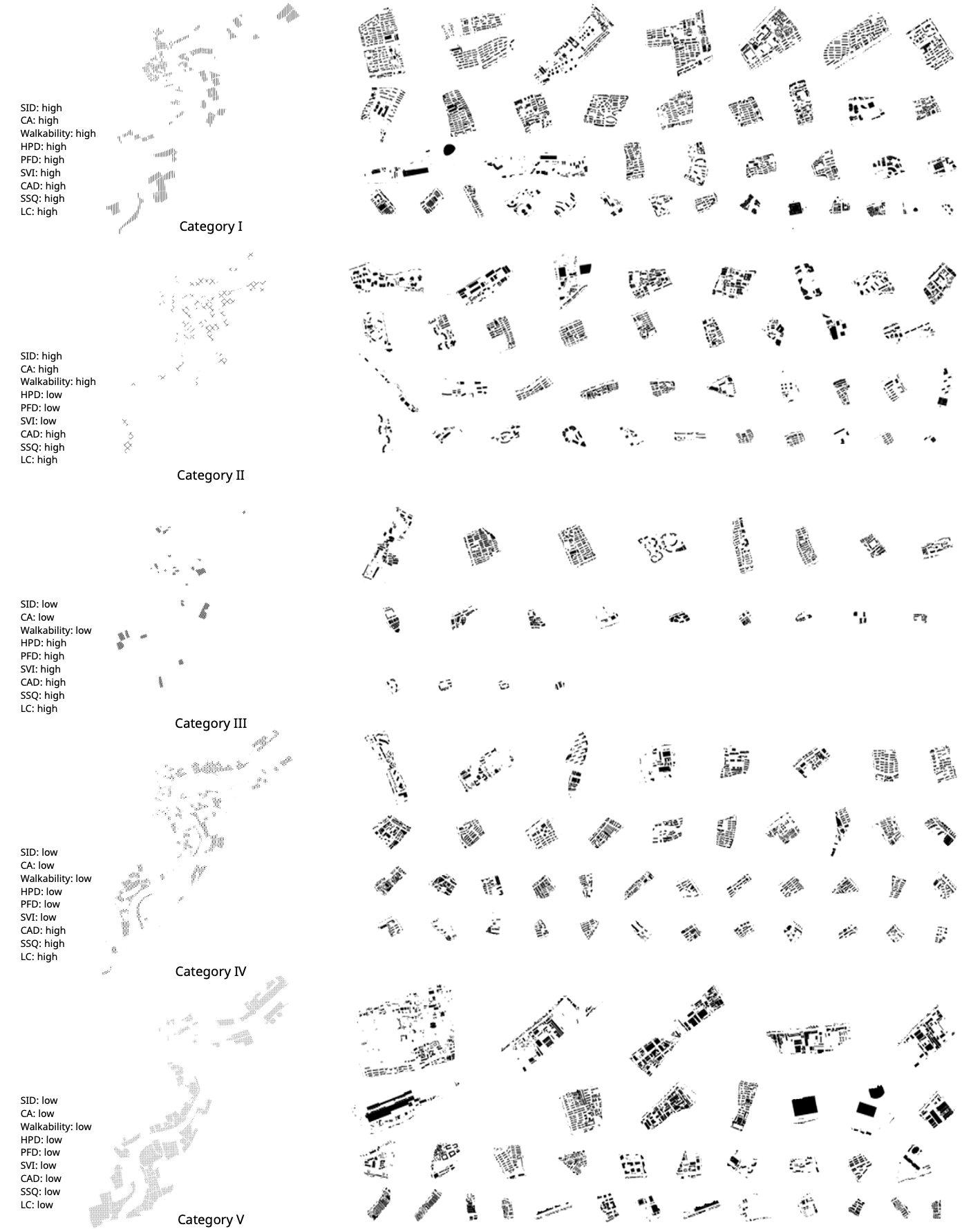
First, the study summarizes the relevant theories on the relationship between urban spatial form and activities. It proposes three dimensions, including spatial form, vitality, and sense of place, each evaluated by three indicators respectively. Second, the 15-minute accessibility area of the waterfront area is obtained through Gaode Map API and GIS spatial difference calculation. Urban blocks divided by the road network are used as statistical units to obtain the scores of the nine indicators for each block. Third, all blocks are divided into five classifications by hierarchical clustering. Finally, the urban fabric of all blocks of each category is clarified and typical cases are selected for analysis, taking the North Bund area as an example for waterfront district renewal design.
Waterfront Research Challenge | Massive Urban Data Disorder
Theory Research
Theory Research


Collage Waterfront | Multi-Source Data Analysis


Clarify Fabric Code | Classification of Urban Block

Renewal Potential | Typical Waterfront Area Study

Renewal Strategies | Waterfront Design Based on Fabric Code

